
If you’d rather listen vs. read, I recorded an entire podcast episode on this topic.
Otherwise, keep reading…
Why I Am Qualified to Talk on This Topic
I am passionate—and qualified!—to share information about marketing and its effect on diet culture for two reasons:
- In 2016, I recovered from a 10+ year battle with bulimia and disordered eating. I can say with honesty that marketing tactics and lack of knowledge about food and exercise contributed to my extreme dieting, food restriction, negative body image, and comparison—which eventually led me to develop a full-blown eating disorder. You can hear more of my story in episode 1 of my podcast, or read about it here.
- I have experience as a marketing professional in my everyday career. I understand how the industry works. I’ve researched and developed strategy and tactics. AND I know how all of it can be used for good—and for evil.
Now, I won’t fully blame marketing and advertising for the choices I made, but the truth is, they did affect me. They were a factor in my downward spiral from dieting to eating disorder. And I don’t want them to affect you. I want to educate you and share God’s truth to knock out the lies and tricky marketing strategies you WILL encounter.
So, let’s dive in…
Marketing Fatigue and Targeting
Outside of my career, in my everyday life, I—just like you—am bombarded with marketing messages throughout my day. They are everywhere, right?
On social media, websites, TV, billboards and radio when you’re driving, in stores, on product labels, and even on podcasts. You really can’t escape advertisements, and that is the goal.
You and I are targets, like it or not.
Now, I want to make a distinction that marketing messages CAN be helpful when products or services can, in fact, benefit or simplify your life in some way.
Whenever new and genuinely beneficial products and services are developed and put out into the world, marketing messages let people know these things exist AND share what the benefits are.
Needs vs. Wants
Yet, in most cases, the things marketed to us on a daily basis are not things we truly need. We could survive and even thrive without them.
In general, there are a lot of things we WANT but we don’t need. And we all do it, right? We all want things. It’s human nature. I’m not judging you because I do it, too. And the wanting itself isn’t wrong.
It’s when wanting becomes coveting and craving and all you can think about… when wanting becomes jealousy… when you start to believe the things you want will solve all your problems and make you happy OR make you more popular and accepted… THAT is when wanting becomes a problem.
Wanting things more than wanting God—or looking for quick fixes instead of trusting God—those are problems. I’m just going to say it.
Proverbs 14:30 (NLT) tells us that, “A peaceful heart leads to a healthy body; but jealousy is like cancer in the bones.”
Just like cancer, jealousy can spread if we let it continue without addressing it.
Being jealous of what other people have or look like IS a weakness, and that is exactly what marketing ads will attack.
So, why am I talking about this?
Well, because everything I’ve said so far applies to food and weight loss products, and how we view our bodies.
Let me take you through some real marketing strategies that can apply to any industry. BUT pay attention to how each of these specifically relate to food, weight loss, and diet culture.
Are you ready?
Effective marketing campaign strategies will very likely tap into at least one of the following:
- Your fears—both rational and irrational
- Your desire to fit in with the popular crowd
- Your desire to have a life that looks like someone else’s
- Maybe even your desire to LOOK like someone else
- Or, the focus will be on your current struggles and things in your life you want to FIX
- The perceived consequences if you DON’T fix or change your life
- The perceived value of a product and what it claims to promise you
Now, let’s break each one of these down.
Fear-Based Marketing
Marketers study you. They study the ideal customer for whatever product they are selling. They understand what motivates you… and often, we are motivated by fear, right?
Fear that we aren’t good enough, pretty enough, skinny enough, rich enough.
Fear that we aren’t valuable as human beings. That we are invisible. Ignored. That we aren’t loveable. That no one will accept us.
And what about the fear of gaining weight? Or fear of not being able to lose weight? Fear that clothes won’t look good on us. Fear of wearing a bathing suit in public. You get the idea.
And of course, there’s the fear of missing out. FOMO.
- Fear of missing out on happiness and fun.
- Relationships and love.
- An easy and fulfilled life.
- Yet, most of the time, an ad isn’t selling you the real deal. A product can’t bring you real happiness, true love, lasting fulfillment. Most of the time, ads are all about instant gratification, not long-term results.
Of course, there are exceptions and exceptional ads out there that don’t take advantage of customers. But this is typically not the case with any diet, health, and fitness industries.
Sadly, your fears will be exploited in some way.
And keep reading, because I am going to share some specific words used in advertising that you’ll want to pay attention to.
But first, let’s talk about wanting to fit in.
Keeping Up with the Joneses
Likely, you’ve heard of this phrase, “Keeping up with the Joneses” or wanting to keep up appearances—whether that means buying expensive luxury items, taking lavish vacations, or focusing on your actual appearance.
Wanting to fit in takes me back to high school… or even elementary school. Those days when wanting to be popular was the ultimate, right?
But even as adults, if we’re honest with ourselves, we still look at other people and want what they have. We want our lives to look like theirs. We want ourselves to look like them.
We fall into the comparison trap.
Maybe they seem to have it all together. Maybe they look skinnier and seem happier.
It’s easy to look at other people and think that if you just had their life, everything would be better. And even though that’s not true, many marketers will use comparison to get to you. To get you to buy what they’re selling, whatever the cost. And by cost, I don’t just mean the dollar amount. I mean the physical, mental, and even spiritual cost of believing a product will transform you into a better version of yourself that everyone else will love.
Spoiler alert: this will not happen. There is no magic product or service or plan you can purchase that will keep you winning at life. People change. Trends change. The world will continue to demand more of you. And ads will tell you that you need more… ads from businesses and from influencers who are paid by those businesses.
Friend, nothing you can buy will bring you happiness. Nothing you see in an ad will make you 100% loved or accepted. Only God can do this… and guess what? He offers this to you for free.
Sometimes, that seems too good to be true, right? We think our problems need a solution that we can see, hear, or touch.
So let’s move on to problems.
Problem-Solution Advertising
Ads love to point out the problems in your life and then show you that THIS product will surely fix it for you. Or, on the flip side, you’ll sometimes see ads pointing out the consequences if you DON’T use XYZ product to fix something in your life—that may or may not actually need fixing.
A common and effective marketing tactic is to remind you of your biggest frustrations and pain points and give you a sense of urgency to fix it NOW.
Here are some pain points and frustrations an ad might target:
- Feeling fat or ugly or [insert whatever negative words you might think about yourself]
- Maybe you can’t seem to lose those last 5 pounds.
- Or maybe you’re frustrated by your lack of willpower when it comes to sweets or any food the world tells you is “bad.” Do some foods have more nutritional value than others? YES. Does that mean you can’t ever eat anything with less nutritional value? NO. That all or nothing thinking will only set you up for failure. Trust me. I know from experience.
These frustrations are rooted in lies from our enemy, the Devil. They are ingrained in our culture and can so easily seep into our minds. I talk a LOT more about lies vs. God’s truth with guests on my other podcast episodes. Be sure to check those out, because here, I want to stick to the marketing.
I need you to understand that the lies you believe about yourself, the things you want to change about yourself, all of it will be used against you in ads targeted right at you. I don’t want to go off on a tangent, but the ads you see are not an accident. Businesses pay to place ads to the “right” audience. They can target you by the topics you search, websites you visit, posts you like on social media, what you watch and listen to, and a whole lot more. If that sounds scary… well, it is.
Scary, but true. You are a target.
Which brings me to the last marketing tactic I want to discuss…
The Perceived Value of a Product
You and I will only purchase something if we think it has value—even if we think this subliminally and even if that value is small. We are exchanging something valuable (aka. money) for something we hope will give at least that much value back.
This is where all of those negative emotions can be used against you. Emotions like:
- Your fears
- Weaknesses
- Struggles and frustrations
- Who you compare yourself to
- What you want to fix about yourself
- What you desire most in life
Don’t be surprised when you see ads using words and images that emphasize both the negative you feel and the positive you could feel if you buy and use THIS product.
Don’t be surprised when you feel like your inner emotions—your deepest, core feelings—are poked and prodded, because that’s what motivates you to take action. It is.
That is your WHY. And the goal of marketing and advertising is to get to your WHY.
Let’s break it down with an example.
- Let’s say you want to go on a diet.
- WHY does going on a diet matter?
- Because you don’t like the way you look in the mirror.
- But WHY does that matter?
- Because other people look smaller than you.
- And WHY does that matter?
- Because they receive more attention and praise.
- And WHY does that matter?
- Because you want to be noticed and liked.
- And WHY does that matter?
- Because you don’t want to feel ignored or unworthy.
- And WHY does that matter?
- Because people who are ignored or unworthy are unloved.
And there you have it. The core feelings are unworthy and unloved.
Now, I’m not saying any of this is true. You are not unloved if you don’t lose weight. Feelings aren’t facts. But feelings DO often control the choices we make in life, right?
Marketers know this. They will tap into your deepest feelings, whatever yours happen to be. And then. Then you will see ads promising you things that products will do to help you overcome these feelings or fix all your problems.
This can be in actual text like, “Lose X pounds in just 2 weeks!”
Or, this could be through visual examples, like side-by-side before and after photos of people who eat certain foods, use certain products, or pay for a certain workout plan. The person in the after photo always seems happier, don’t they? That’s not by accident. It is meant to make you feel something and want that seemingly better life.
Maybe you’ve seen ads like this. Maybe some are popping up in your head right now.
Maybe you’ve purchased a product out of fear, or shame, or comparison, or wanting to be noticed. I am not judging you. I’ve done it, too.
My point is not to shame or judge you, but to make you aware of what is being thrown at you. I want you to know you are a target so you can spot the lies, spot the marketing tactics, and make more informed choices about the products you purchase—especially things related to food, diet, exercise, and overall health.
Before I dive into specific keywords to watch out for, let me emphasize again that not all products marketed toward your health are a sham. Some can help you live a healthier life—not one of comparison or restriction or only wanting to be skinny, but one where you care for your body.
What Does the Bible Tell Us About Caring for Our Bodies?
Let’s first look at Romans 12:1-2 (NLT), where the Apostle Paul writes: “I plead with you to give your bodies to God because of all he has done for you. Let them be a living and holy sacrifice—the kind he will find acceptable. This is truly the way to worship him. [2] Don’t copy the behavior and customs of this world, but let God transform you into a new person by changing the way you think. Then you will learn to know God’s will for you, which is good and pleasing and perfect.”
By offering our bodies and ourselves wholly to God, we must be a good steward of the body God gave us. That doesn’t mean obsession with looking skinny or fit or magazine worthy. That’s why verse two tells us NOT to copy what the world says is the standard.
But let’s back up to verse one. WHY should we give our bodies to God? “Because of all he has done for you.”
1 Corinthians 6:20 (ERV) puts it like this: “God paid a very high price to make you his. So honor God with your body.”
That “high price” was sending His son, Jesus, to die a brutal death of crucifixion on a cross to cover the payment for your sin and mine. AND, because Jesus didn’t stay dead—because he rose from the grave and defeated death—you and I are free from the control and eternal punishment of sin. We are free from the control of this world and what it tells us we should do and who we should be and what we should look like.
Because God is not concerned with our physical appearance as much as He is with our heart and mind. 1 Timothy 4:8 (NLT) tells us that, “Physical training is good, but training for godliness is much better, promising benefits in this life and in the life to come.”
In fact, the Bible warns us not to DESTROY our bodies—which food restriction, overexercising, unhealthy weight loss, and even eating disorders can certainly do. Where can you find this in the Bible? 1 Corinthians 3:16-17 (NLT):
“[16] You should know that you yourselves are God’s temple. God’s Spirit lives in you. [17] If you destroy God’s temple, God will destroy you, because God’s temple is holy. You yourselves are God’s temple.”
And the last verse I’ll share here is 1 Corinthians 10:31 (NLT) “So whether you eat or drink, or whatever you do, do it all for the glory of God.”
Note that God doesn’t tell us how our bodies should look. He doesn’t tell us what to eat or drink to get lean or toned or lose weight. That’s because taking care of our bodies isn’t about bringing US attention and praise. It’s about bringing glory to God.
And, it should go without saying that marketing messages that tell you how to change your body are not from God. My suggestion is to take any message you hear or see or read TO God and ask Him what He thinks about it… or ask Him to reveal the truth to you.
And finally, let’s talk about the diet trends, buzzwords, and phrases to beware of when you are trying to discern the truth.
Diet Trends and Diet Culture Buzzwords
Let’s start with the trends.
Have you noticed how every year or so there seems to be a new health or diet trend?
When I was a teenager in the 90s, everything had to be low fat. Many diet plans emerged, from Slim Fast to Special K. Then, carbs became the enemy with the South Beach Diet. And low carb morphed into the keto craze, which tells us fat is not only okay but encouraged in larger amounts.
I could go on…
- High protein
- Low sugar
- Paleo
- Liquid diets
- Detoxes
I’m sure you could list more, too.
But let’s look at some…
Diet Statistics
According to data from the Medical Clinic of North America:
- More than half of all weight lost in diets is regained within 2 years.
- By year 5, more than 80% of all weight lost is regained.
Another set of studies quoted by UCLA found that:
- In less than two years, 23% of people gain more weight than they lost.
- More than two years after dieting, 83% gain more than they lost.
- A final study followed up on dieters after 5 years, and 50% of them were 11 pounds over initial weight.
My point is, the best weight loss diet is always changing. Always a new diet trending. And friend, that is marketing in action. Marketing strategy for this industry thrives on new, new, new to capture new audiences and keep existing dieters engaged. AND sadly, this tactic draws attention away from the fact that diets don’t work long term—as the statistics prove.
Ads for diet foods and weight loss products and services WILL target you and feed on your:
- Fears
- Weaknesses
- Struggles and frustrations
- Who you compare yourself to
- What you want to fix about yourself
- What you desire most in life
All things I noted earlier.
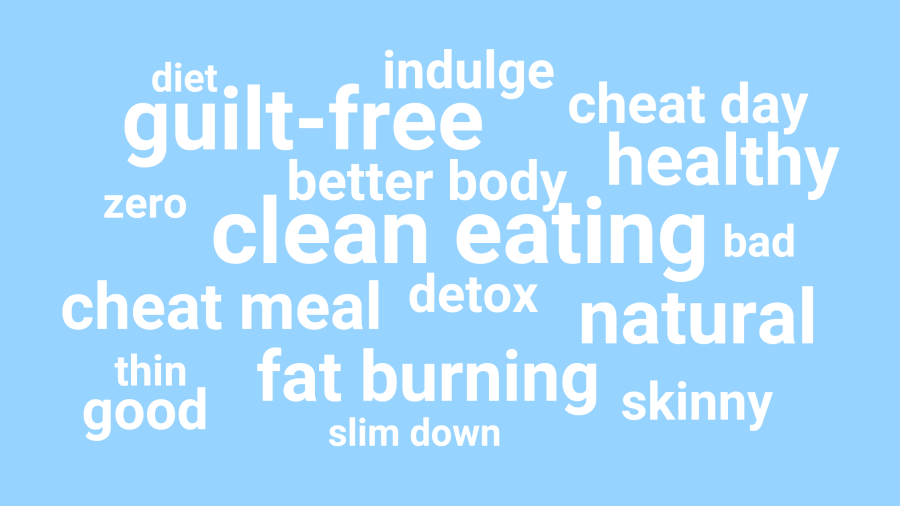
So HOW are you targeted? With those buzzwords and phrases that I promised I’d get to.
Many of these buzzwords used in marketing for diet and weight loss foods and products have no standard definition or regulation for use. The goal is to catch your attention and trigger an emotion.
Here are some examples:
“Guilt-free” — I know you’ve seen this on food packaging. “Guilt free” implies you should feel guilt or shame for certain things you eat… but this food is safe. There is no standard for which foods can claim to be “guilt free,” so seeing these words can be misleading and send a harmful message about guilt around food.
You may also see phrases like “indulge without guilt” — which is meant to imply that eating it will make you feel like you’re not on a diet, yet it’s somehow better for you. Notice I said somehow, because again, these words are not regulated in how they can be used.
What about “clean eating”? That’s a hot phrase right now to focus on eating all natural, organic, unprocessed, and whole foods. Of course, there is nothing wrong with eating less processed foods and, in truth, those do offer benefits for your body. But, the danger here is making it an obsession, that you can ONLY eat “clean” foods, and if you don’t, you’re not healthy or won’t achieve the ideal body. Often, orthorexia can develop from clean eating. If you haven’t heard of orthorexia, it’s a medical condition in which the sufferer systematically avoids specific foods in the belief that they are harmful. Here’s a link with more details on orthorexia and its negative effects.
You’ve definitely heard of a “cheat meal” or “cheat day” right? The word “cheat” isn’t necessarily a marketing term used by brands, but fitness professionals and influencers certainly use it to market their eating plans and weight loss regimens for body goals. I’m going to be real with you, though. A cheat day or a cheat meal is a planned binge. Before I developed bulimia, I relied on cheat days to cope with my otherwise too restrictive diet. I was either “cheating” on my diet or not eating anything. Cheat days are a slippery slope. Trust me!
Okay, let’s get literal with words like SKINNY, SLIM, and THIN. Brands put these on food labels and even in their own company names. Right in your face, so you will add them to your cart with the hope they will indeed make you skinny or thin. Please understand, I am not here to shame you if you are buying these products. I have been there, done that myself and I only want to emphasize that, if the only reason you buy something is because a word on the packaging promises you a different body—that is a marketing strategy taking advantage of you. Now, if you genuinely like a product, regardless of what the packaging tells you, by all means… enjoy!
I’m sure you’ve seen foods labeled “natural” or “all natural” or “made with natural ingredients,” right? Here’s what the USDA government website has to say about that.
“Regulatory agencies treat the ‘natural’ claim as meaning nothing artificial was added during processing and the product was minimally processed, so food suppliers can use it at a relatively low cost. Regulatory agencies’ policies regarding the ‘natural’ label do not address human health, the use of synthetic pesticides, genetically modified organisms, hormones, or antibiotics in crop and livestock production.”
If you think seeing the word “natural” on a food label means it’s healthier, the USDA says that may not be true. But you can be sure you WILL pay more for that product because of the word “natural” attached to it. Once again, this is used as a marketing strategy that not only DOESN’T help your body or your health, and DOES make your grocery bill higher.
Now let’s talk about “Superfoods.” According to the Harvard School of Public Health, there is “no scientifically based or regulated definition for superfood, but generally, a food is promoted to superfood status when it offers high levels of desirable nutrients, is linked to the prevention of a disease, or is believed to offer several simultaneous health benefits beyond its nutritional value.” Again, I linked this source in the show notes for you to read yourself. While it may be true that a food offers desirable nutrients and could help prevent diseases, it’s not guaranteed. Companies that put “superfood” on a label are capitalizing on you believing that food is superior and will help you achieve your health and body goals—all with no standard to back it up.
The word “healthy” IS actually regulated by the FDA (Food & Drug Administration) based on higher nutrition ratings. I linked more information on this in the show notes. But, while it can be helpful to know which foods contain more nutrients, please understand that if you buy something not labeled healthy, that doesn’t make YOU unhealthy or bad for eating it. You shouldn’t feel ashamed about it.
If you have an Instagram or TikTok account, I KNOW you’ve heard the term “healthy swap,” too. This isn’t so much used by brands as it is by influencers—often in the health and fitness space—who may or may not be licensed professionals and who are probably not using the word “healthy” according to FDA regulations. My point here is not to call anyone out, but to do your own research when you hear social media influencers tell you that something is healthy or will help you look like them. This also ties back to my earlier thoughts on comparison and fear of not fitting in with the world.
Okay, I’ve focused mainly on food here, so I want to switch gears for a minute to messaging about weight and your body.
The words SKINNY, SLIM DOWN, and THIN definitely apply here, too. Any product, food or otherwise, that uses these words as a vague promise to change your body is a marketing tactic that plays to your deepest emotions.
Or, maybe you’ve seen phrases like “better body” or “macro friendly” or “fat burning.” Or ads that claim you can lose X pounds in just two weeks. If it sounds too good to be true, it probably is.
I’ll stop here but I hope you get the point.
I hope you look at ads and product packaging differently now—especially the ones targeted at losing weight and changing how you look.
Please, please, please use discernment. Please do not assume that everything you read is true or has your best interest in mind. Remember, many of the most effective ad campaigns are targeting you. They are targeting…
- Your fear of not being loved or accepted
- Your longing to fit in
- Your current struggles with body image or your appearance
- Your deepest emotions
I want you to be aware and informed.
I want you to be wary of any ad or product that promises you a better life. A happier life. A skinnier body.
Losing weight will not make you happy. At my skinniest weight, I was miserable—and many others I know who recovered from eating disorders would tell you the same.
God did NOT create us to be miserable. He did NOT create us to be satisfied with temporary things. He created us each with a unique life. A unique body. A unique soul.
God did not create a standard for the perfect body. The world did that, and the standard for perfection is constantly changing. And you know marketing and advertising will always keep up with the latest to get you to buy something.
DON’T let this world tell you how you should look.
DON’T let an ad convince you that you need anything.
TRUST God—not the ever-changing preferences of society.
TRUST His Word—not the often empty promises of an ad.

 adventure and the girl